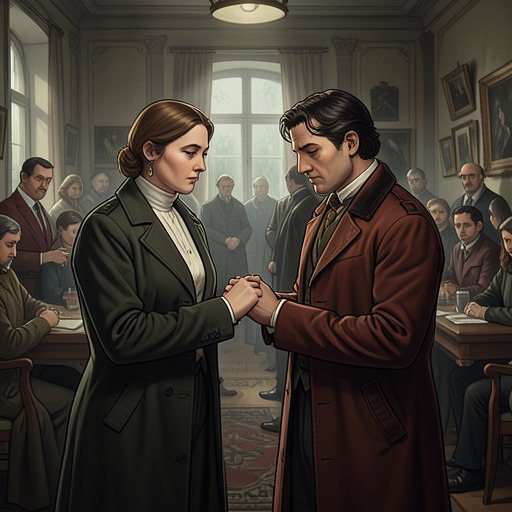
Jacqueline's pursuit of the Doyles
Death on the NileJacqueline's pursuit of the Doyles is the deliberate, continuing shadow over Linnet and Simon's honeymoon. What begins as a conspicuous appearance at successive destinations becomes a tactic Jacqueline says she chose for the distress it would cause. Her pursuit helps make the couple's private happiness feel exposed and precarious; later, the fact that she had confronted Simon and was associated with a pistol gives investigators an apparently straightforward explanation for Linnet's murder that proves misleading.
Origins and Course of the Pursuit
Linnet describes the pursuit to Hercule Poirot as an intolerable persecution and says she had considered going to the police. Simon, however, believes the police would be powerless to stop it. Her account makes clear that Jacqueline's appearances are not confined to one place: the first occurs in Venice, where Linnet initially assumes it is coincidence; the couple then encounter her aboard a boat at Brindisi, although they believe she is travelling to Palestine. When they reach Mena House, she is there too. The sequence turns each apparent departure into another encounter and persuades Linnet that the pattern is intentional.
The pursuit continues as the couple travel. As the steamer leaves its jetty for a seven-day journey to the Second Cataract and back, Linnet turns at the sound of Jacqueline's laugh and finds her standing there, seemingly amused. Jacqueline acts surprised to find them and recalls that Linnet had said she would remain in Aswan for another ten days. Linnet falters before managing a conventional greeting. The exchange shows that even a brief encounter can unsettle the newlyweds: Jacqueline's presence makes their movements and plans feel known to her, while her light manner leaves Linnet with little obvious grounds for a public complaint.
Jacqueline's Chosen Method
In her conversation with Hercule Poirot, Jacqueline explains that she first considered killing one of the couple but could not decide which; she regarded either choice as unsatisfactory. She then decided to wait and follow them. Rather than end the conflict immediately, she would appear wherever they went while they were together and happy. She says this approach affected Linnet deeply, and that she came to enjoy the effect. The pursuit is thus presented not as accidental proximity but as a chosen form of retaliation, sustained through repetition and the knowledge that Linnet cannot easily make it stop.
Jacqueline describes maintaining a pleasant and polite manner during these encounters. That contrast is central to the method: outward civility does not mean reconciliation, but conceals a deliberate effort to poison the couple's experience of their honeymoon. Her statement that there is nothing Linnet can do about it expresses the imbalance she seeks to create: Jacqueline controls whether she appears, while Linnet and Simon must continue their journey with the possibility of another encounter hanging over them. The pursuit's force lies in recurrence, not in any single confrontation.
Effects on the Couple and Others
The strain is visible to people who encounter Linnet and Simon. After seeing them, Tim Allerton calls Simon fortunate to have found an heiress, while Rosalie Otterbourne remarks that they look extremely happy. Rosalie then quietly says that the situation is not fair, a remark Hercule Poirot hears and asks her about. The exchange does not establish precisely what Rosalie means, but it places the couple's visible happiness beside another person's sense of unfairness. That contrast resonates with the pursuit: the honeymoon appears enviable from the outside, even as Jacqueline's repeated presence has made it a source of distress for Linnet.
Linnet's appeal to Hercule Poirot also shows how the pursuit changes her sense of security. She presents it as an ongoing problem requiring intervention, but Simon doubts that ordinary legal authority can help. Jacqueline's manner compounds that difficulty: as Linnet recounts it, the persecution is sustained through appearances that remain outwardly polite. The couple therefore face not simply an unpleasant meeting but the repeated loss of privacy as they move from one destination to another.
Role in the Murder Investigation
After Linnet is murdered, Jacqueline's history with the couple becomes a powerful basis for suspicion. Hercule Poirot initially reasons that someone wished to kill Linnet, overheard the confrontation between Jacqueline and Simon, retrieved Jacqueline's pistol, and used it to implicate her. The letter J on the wall appears to support that account. Yet the pistol's removal from the scene contradicts the simple framing theory: if the killer meant to make suspicion point toward Jacqueline, leaving the weapon would seem more useful than throwing it overboard.
Hercule Poirot later acknowledges that he and Colonel Race began with the mistaken assumption that the killing was spontaneous and opportunistic. Once he abandons it, the case changes shape: he identifies the murder as carefully planned and timed in advance, including the drugging of his wine to keep him from taking part in the night's events. Jacqueline's pursuit remains relevant because her real hostility and visible association with the pistol make the false explanation persuasive. The same campaign that tormented Linnet also supplies the investigation with a compelling but incomplete story about motive and opportunity.